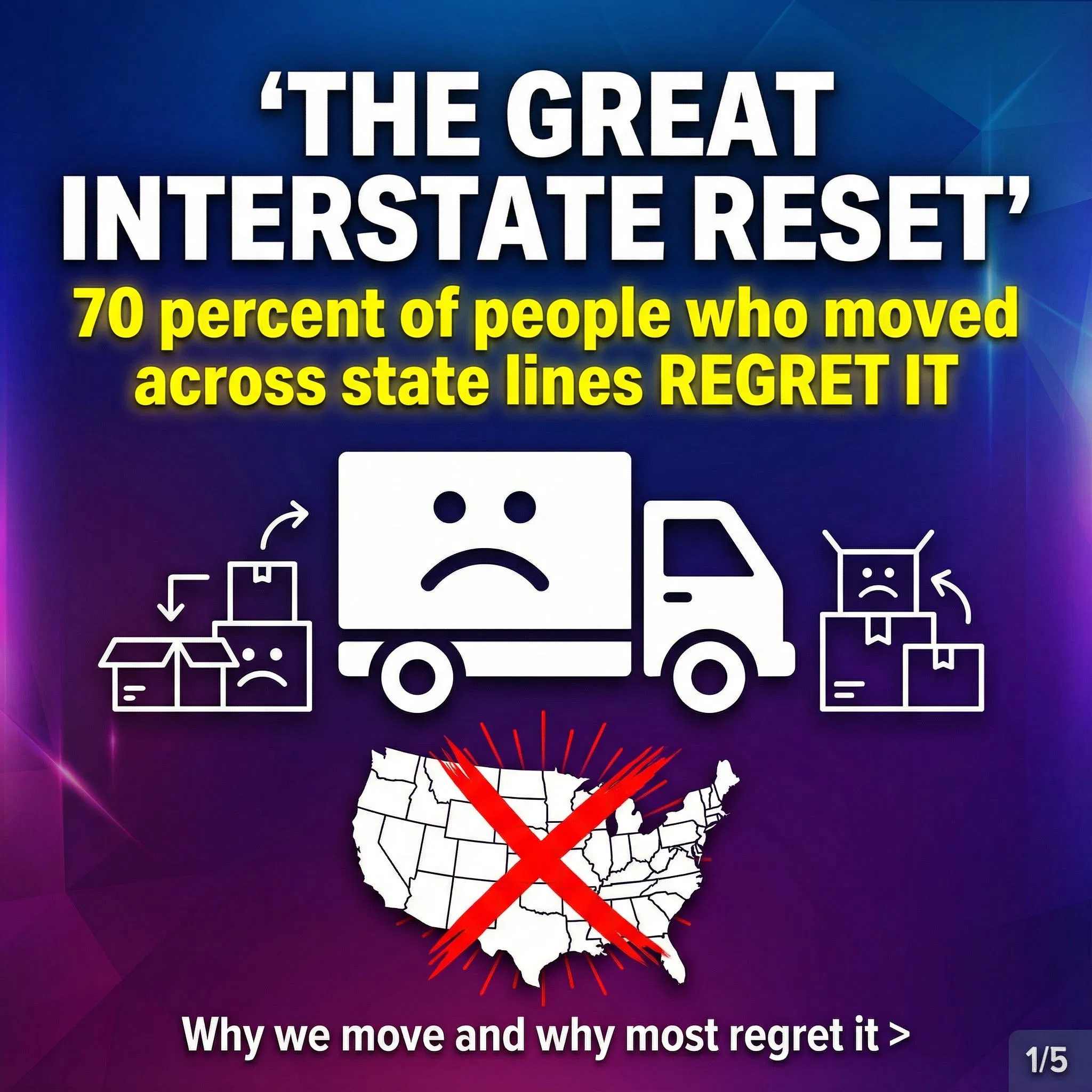
The Great Interstate Reset: Why We’re Moving (and Why 70% Regret It)
There is a certain magic in looking at a map and imagining a version of yourself in a different zip code. We’ve all done it: picturing a “new me” in a place with better vistas, shorter commutes, and a slower pace. But as recent data from the 2025-2026 moving cycle shows, there is a massive gulf between the dream and the destination.
If you’re considering crossing state lines this year, here is the reality of the “Great American Move.”
1. The Naivety Gap
According to recent surveys, 70% of Americans who moved across state lines last year ended up with regrets. Why? Because many of us are romanticizing the “fresh start.”
It’s easy to imagine the new life; it’s much harder to survive the stress of the “naivety gap.” This is the space between the comfort you have now and the landing in a place where you have no roots. Unless you have a compelling upside: like a job that truly excites you or a family member who needs you—the move can often fall flat. Without a “Why” that outweighs the “How,” the logistics will eat your enthusiasm alive.
2. Quality of Life vs. The Paycheck
The data is clear: people are fleeing high-cost hubs like California and New Jersey for “inbound” states like Idaho, Oregon, and South Carolina. Having personally traded the 24/7 energy of Las Vegas for the smaller, slower pace of Idaho, I can tell you: once your basic needs are met, quality of life wins every time.
We are seeing a national trend where “smaller and slower” is becoming the new “bigger and better.” When you value your time more than your prestige, a smaller state starts looking like a major upgrade.
3. The Professional Mover: A Necessary Evil?
Let’s talk about the price tag. Moving a 3-bedroom home 1,000 miles can now cost upwards of $7,800. While that’s a bitter pill to swallow, the alternative is often worse.
Not everyone is comfortable piloting a 26-foot freight truck across mountain passes, and very few people have 10-20 friends they can call on for a weekend of back-breaking labor. Professional movers aren’t just a luxury; they are a required piece of the puzzle to avoid property damage and physical burnout. We can only hope that as fuel prices stabilize, we’ll see a better equilibrium in these costs.
4. The Return to the “Support Net”
For the first time in modern history, being closer to family has surpassed career relocation as the #1 reason for moving.
This signals a massive shift in American values. Because we are more educated and skilled than ever, thanks to the rise of specialized trades and remote-capable degrees, we have more flexibility. We are no longer chained to a specific city for a paycheck. This allows us to prioritize community and support systems, the “built-in” help that makes raising a family possible.
The Bottom Line
Moving isn’t about the truck or the boxes; it’s about the “Why.” If you’re moving just to run away, you’ll likely end up in that 70% of people with regrets. But if you’re moving toward a support system and a pace of life that matches your values, the “naivety gap” is a price well worth paying.