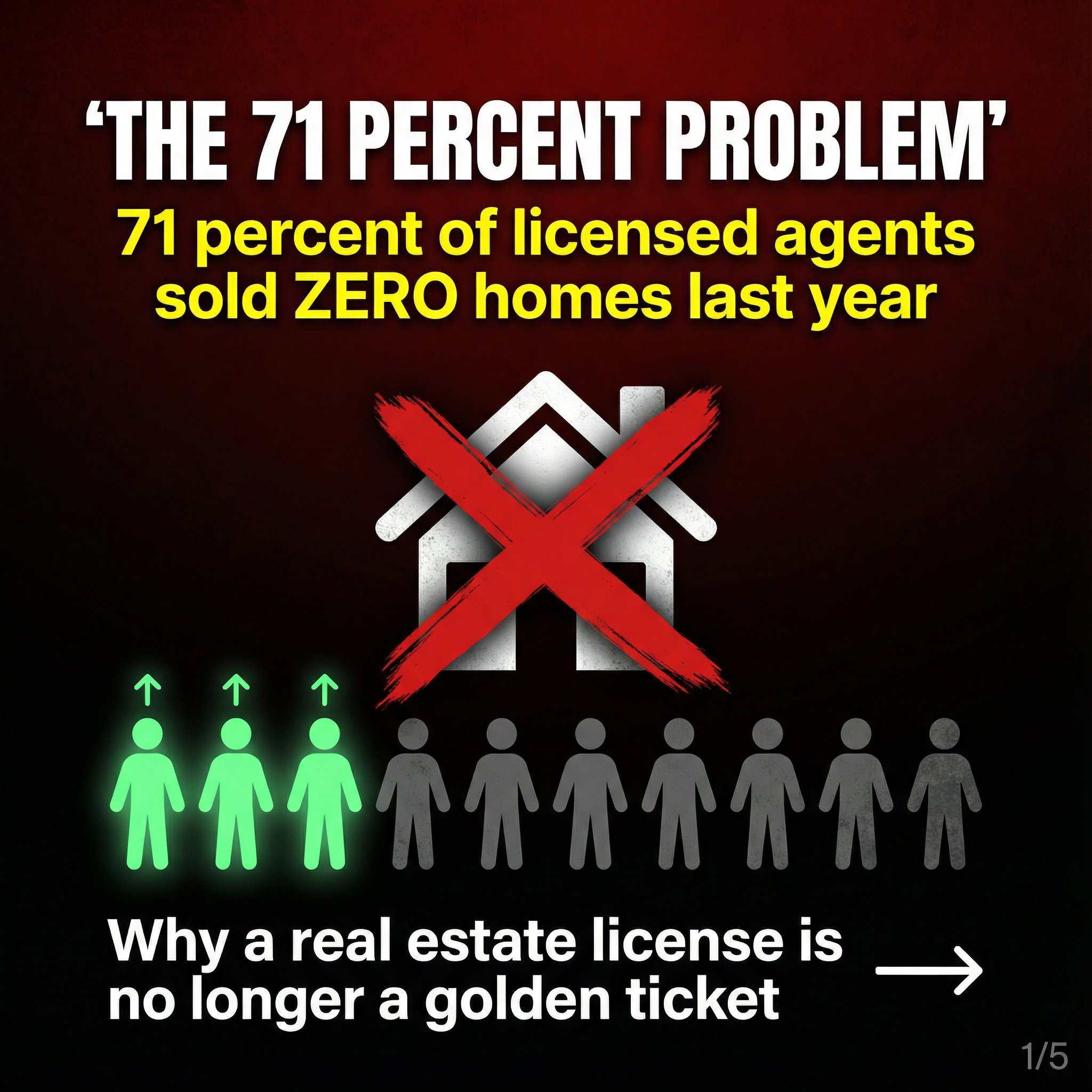
💣 The 71% Problem: The Uncomfortable Truth About Real Estate Licenses in 2026
If you were at a dinner party five years ago and mentioned you were thinking about getting your real estate license, your friends probably cheered. In the “easy money” era of 3% interest rates and houses selling themselves, a license felt like a low-cost entry into a high-profit world.
Fast forward to 2026, and the conversation has changed dramatically.
I recently spoke with a newly licensed friend who was genuinely shocked by the reality of the “Pay to Play” system. Another Realtor shared a startling statistic that’s been making waves in the industry: Last year, roughly 71% of licensed agents didn’t sell a single home.
If you’re thinking about jumping in, you need to look past the “boss babe” Instagram aesthetic and understand the industrial machine you’re about to feed.
The “Pay to Play” Reality Check
Most people think getting licensed is just about a 90 hour course and a state exam. That’s the cheap part. The real sticker shock happens the moment you want to actually work.
The industry is dominated by a mandatory hierarchy often called the Three-Way Agreement. To get access to the MLS (the database you need to see what’s actually for sale), you are almost always forced to join your LOCAL board. That triggers a domino effect: you are then required to pay dues to your STATE association and the NATIONAL Association of Realtors (NAR).
In 2026, those combined annual dues—plus MLS software fees, electronic key access, and your broker’s “desk fees”—can easily top $2,500 to $3,000 before you’ve even made a phone call.
Here’s the breakdown: • NAR + State + Local dues: $500-$900 • MLS access: $300-$500 • E-Key/Lockbox: $200-$300 • Broker desk fees: $1,000-$2,000
For the 71% of agents who don’t close a deal, that’s not a business expense; it’s a donation to an antiquated system.
Don’t Be a Victim of the Machine
The current real estate landscape is built to profit from the transaction, not necessarily the consumer or the individual agent. Massive players like NAR, Zillow, and the legacy “Big Box” brokerages have created a system where they get paid regardless of whether you, the buyer or seller, actually win.
The industry is currently being disrupted by lawsuits and technology, and frankly, it’s about time. It is an antiquated model that is finally being forced into transparency.
If you are a buyer or seller today, you have to be on your toes. You cannot assume the “system” has your best interest at heart when the system is busy collecting dues from 1.5 million agents, the majority of whom are statistically inactive.
The Strategic Pivot: Use the License, Don’t Let It Use You
Does this mean a license is worthless? Absolutely not. But it means you need a strategy.
Take my aunt, for example. She didn’t get her license to “see if she could make some money.” She got it to facilitate her and my uncle’s specific business plan: developing and selling their own lots. By holding the license, she cuts out the middleman, retains more equity, and controls the data. She isn’t a “ghost agent” feeding the NAR machine; she’s a business owner using a tool.
I’ve spent years toggling between high-volume sales and acting as a strategic consultant. The most successful people I see in 2026 are the ones who treat the license as a technical tool, not a career identity.
My Advice: The “Strategy First” Rule
The 71% fail because they get the license and then look for a plan. In this market, you will get eaten alive by fees before you find your footing.
Before you spend a dime on a licensing course, ask yourself:
- Is this for a specific project? (Like my aunt’s development deals)
- Do I have the tech-stack to compete? (In 2026, if you aren’t using AI for lead nurturing, you’re already behind)
- Am I okay with the “Pay to Play” tax? You are entering a system that requires a multi-thousand dollar “buy-in” every year just to keep your seat at the table.
The Bottom Line: Don’t get a license to “try it out.” Get a license because you have a specific, mathematical reason to own the data and control the transaction.
Are you or someone you know thinking about taking the plunge into real estate? I’d love to help you run the numbers. I offer a first-year “Survival Budget” template that breaks down the actual local, state, and national costs you’ll face in Southeast Idaho. DM me or comment below.